 CZ
 EN


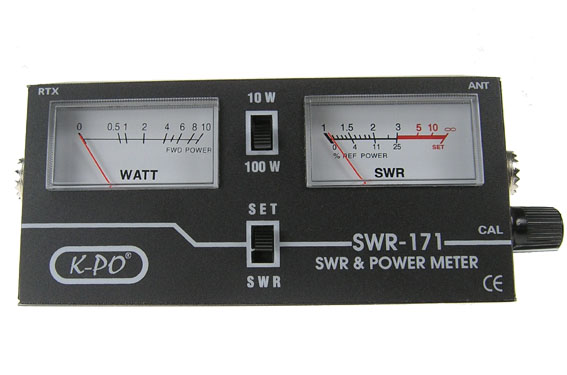
K-155 / SWR 171
Technical specifications are subject to change without prior notice. Images are for illustrative purposes only.
Code:3360020,00
Manufacturer:KPO
Availability:
In stock (2 see)
Rudná: 2 see
Počernice: 0 see
Price without VAT: 579 ,-
price with VAT: 700 ,-
price with VAT: 700 ,-
A device for basic checking of antenna and radio station power settings, with two meters.
Technical specifications:
* Impedance: 50
ohms* Max. input power: 100 W*
Frequency range: 26–30
MHz* W-meter ranges: 10/100
W* Accuracy: ± 5%*
Connectors: SO 239
VSWR measurement procedure:
Connect the VSWR meter between the radio and the antenna using a short 50-cm connecting cable. Plug the cable into the radio in place of the antenna and connect the other end to the PSV meter’s connector, most commonly labeled TCVR.
Then connect the antenna to the second connector on the PSV meter labeled ANT. If the PSV meter has a wattmeter, set the PWR-SWR switch to the SWR position. This completes the setup for the measurement.
The measurement itself involves calibrating the deflection of the PSV meter’s pointer. On the meter, set the switch to the FWD position and tune the microphone to a broadcasting station; use the rotary potentiometer on the PSV meter to adjust the pointer deflection to the end of the scale—the SET position.
Then switch the selector switch to the REF position, key in, and the needle will display the PSV value.
If the value is between 1 and 1.5, no action is needed on the antenna; maximum losses due to mismatch are up to 4%.
If the value is higher—2 or more (i.e., 11% loss or more)—it is advisable to fine-tune the antenna.
For CB antennas, tuning is performed by changing the length of the radiator—by extending or shortening it—or, if necessary, by adjusting the rings on the antenna body.
It depends on whether the antenna is tuned below the band—in which case you shorten it—or above the band—in which case you lengthen it.
!! However, we recommend leaving this to a professional with experience in tuning!!
Excessively shortening the radiator is an irreversible process and means you’ll have to purchase a new replacement wire.
If you have any questions about this product, please don't hesitate to contact us!