

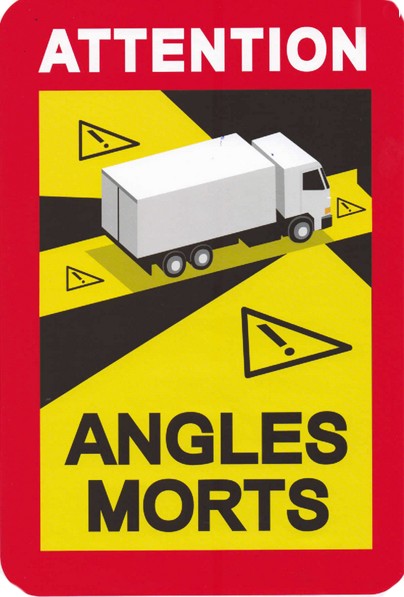
"Blind Spot" magnet on a magnetic board measuring 25x17 cm.
Technical specifications are subject to change without prior notice. Images are for illustrative purposes only.
Code:9910340,00
Manufacturer:
Availability:
In stock (at least 20 pieces)
Rudná: at least 20 pieces
Počernice: 9 see
Price without VAT: 124 ,-
price with VAT: 150 ,-
price with VAT: 150 ,-
“Blind Spot” magnet on a 25x17 cm magnetic board.
Effective January 1, 2021, vehicles in France with a gross vehicle weight rating exceeding 3.5 metric tons (both trucks and passenger vehicles) are required to display so-called “blind spots” marked on the vehicle in such a way as to ensure maximum visibility, particularly for cyclists, pedestrians, and users of personal transportation, and the markings must be visible from the sides and rear of the vehicle.
The regulation also applies to vehicles registered abroad.
Exceptions are made for agricultural and forestry vehicles, as well as winter maintenance vehicles and official vehicles of road and highway authorities.
Failure to comply with this requirement may result in a Class 4 fine.
For example, a tractor-trailer combination requires 6 signs.
Placement of signs on the vehicle:
The markings must be visible under all circumstances and, at the same time, must not obstruct the visibility of the vehicle’s registration plates and other markings, lights, and signaling devices, nor must they interfere with the driver’s field of vision.
The markings must not be placed on the glass parts of the vehicle.
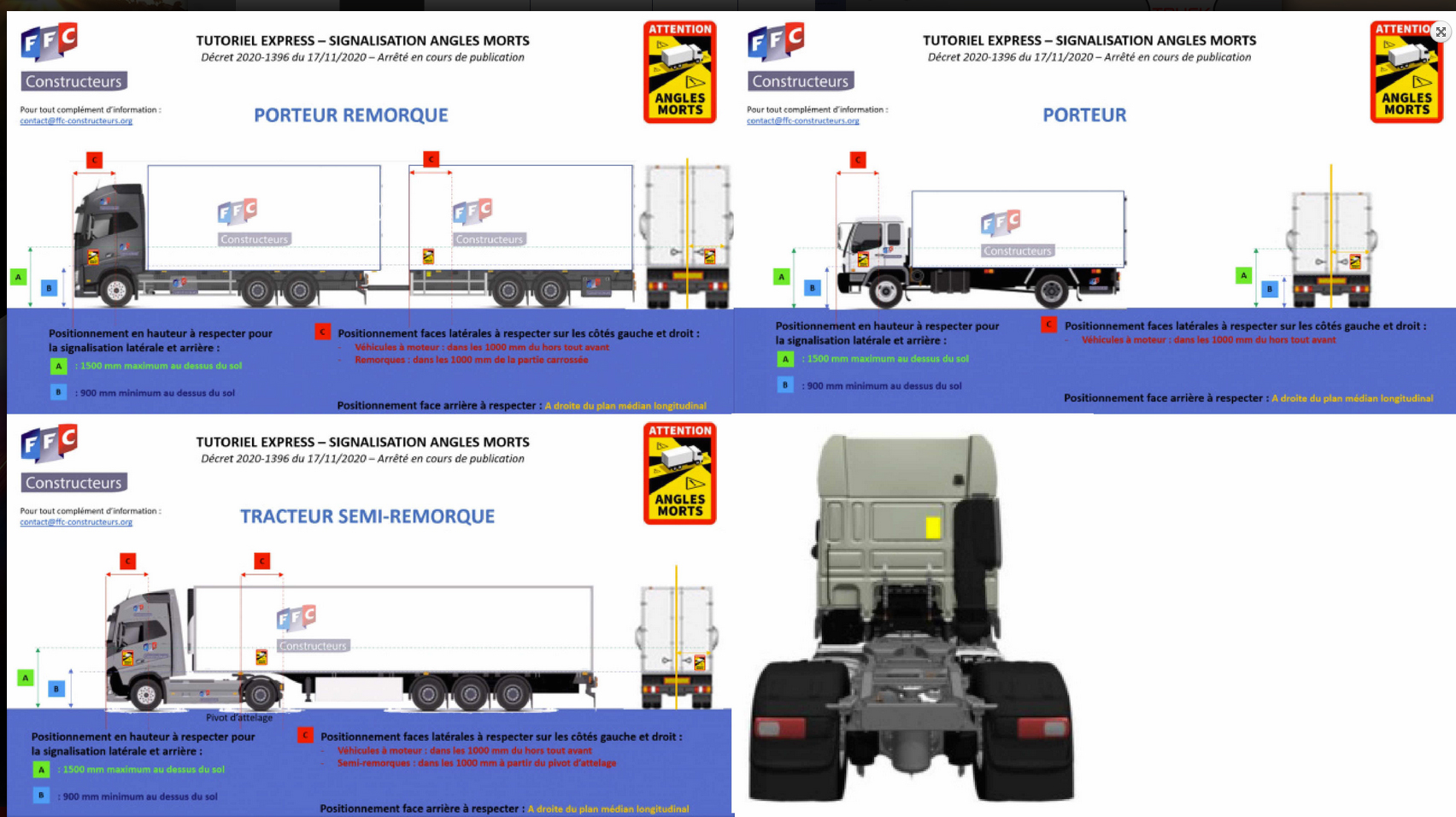
Illustration of the position of markings on the vehicle:
Markings must be present on both the motor vehicle and the trailer;
all markings on the vehicle must be placed at the prescribed height measured from the ground: a minimum of 0.90 m and a maximum of 1.50 m;
on the front of the vehicle, they shall be placed on both the left and right sides at a distance of up to one meter from the front of the vehicle; for semi-trailers, the distance is one meter behind the trailer’s coupling pin;
at the rear of the vehicle, the marking shall be placed to the right of the centerline.
Notes:
Motor vehicles and towed vehicles for which it is technically impossible to meet the requirement for the prescribed sign height (measured from the ground) shall have the signs placed as close as possible to the upper limit, but no higher than 2.10 m;
Vehicles with direct-view systems at the bottom of the doors or with glass doors shall be equipped with signs placed at a distance from the front of the vehicle as close as possible to the prescribed distance, with a tolerance of 10 feet. The 3-meter distance requirement may be waived if the vehicle’s design does not allow the signs to be placed without being positioned on its glazing;
The criteria for the placement of rear markings do not apply to vehicles for which this is technically impossible—for example, containers, tankers, flatbed trucks, detachable bodies with booms, etc. These vehicles will have the markings placed on the rear as much as possible.
The criteria for the placement of side markings do not apply to towed vehicles for which this is technically impossible, and the markings will be placed in the position permitted by their design.
Motor vehicles and towed vehicles for which it has been demonstrated that the installation of markings is impossible due to their design are exempt from the requirement to mark “blind spots” on the sides and/or at the rear.
Effective January 1, 2021, vehicles in France with a gross vehicle weight rating exceeding 3.5 metric tons (both trucks and passenger vehicles) are required to display so-called “blind spots” marked on the vehicle in such a way as to ensure maximum visibility, particularly for cyclists, pedestrians, and users of personal transportation, and the markings must be visible from the sides and rear of the vehicle.
The regulation also applies to vehicles registered abroad.
Exceptions are made for agricultural and forestry vehicles, as well as winter maintenance vehicles and official vehicles of road and highway authorities.
Failure to comply with this requirement may result in a Class 4 fine.
For example, a tractor-trailer combination requires 6 signs.
Placement of signs on the vehicle:
The markings must be visible under all circumstances and, at the same time, must not obstruct the visibility of the vehicle’s registration plates and other markings, lights, and signaling devices, nor must they interfere with the driver’s field of vision.
The markings must not be placed on the glass parts of the vehicle.
Illustration of the position of markings on the vehicle:
Markings must be present on both the motor vehicle and the trailer;
all markings on the vehicle must be placed at the prescribed height measured from the ground: a minimum of 0.90 m and a maximum of 1.50 m;
on the front of the vehicle, they shall be placed on both the left and right sides at a distance of up to one meter from the front of the vehicle; for semi-trailers, the distance is one meter behind the trailer’s coupling pin;
at the rear of the vehicle, the marking shall be placed to the right of the centerline.
Notes:
Motor vehicles and towed vehicles for which it is technically impossible to meet the requirement for the prescribed sign height (measured from the ground) shall have the signs placed as close as possible to the upper limit, but no higher than 2.10 m;
Vehicles with direct-view systems at the bottom of the doors or with glass doors shall be equipped with signs placed at a distance from the front of the vehicle as close as possible to the prescribed distance, with a tolerance of 10 feet. The 3-meter distance requirement may be waived if the vehicle’s design does not allow the signs to be placed without being positioned on its glazing;
The criteria for the placement of rear markings do not apply to vehicles for which this is technically impossible—for example, containers, tankers, flatbed trucks, detachable bodies with booms, etc. These vehicles will have the markings placed on the rear as much as possible.
The criteria for the placement of side markings do not apply to towed vehicles for which this is technically impossible, and the markings will be placed in the position permitted by their design.
Motor vehicles and towed vehicles for which it has been demonstrated that the installation of markings is impossible due to their design are exempt from the requirement to mark “blind spots” on the sides and/or at the rear.
If you have any questions about this product, please don't hesitate to contact us!