 CZ
CZ EN
EN

How to Choose the Right Voltage Converter
Practical Applications of Power Converters
Voltage inverters are ideal for powering appliances in locations where the electrical grid is not available. They are suitable for laptops, televisions, electric kettles, microwaves, or power tools at a vacation home. Owners of home power systems with solar panels can use an inverter to convert direct current (DC) to 230 V alternating current (AC), which is ideal for powering household appliances.
You can connect the inverter to a car battery using cables with clamps, or use a model with a car plug that you simply plug into the car’s cigarette lighter.
Types of Inverters
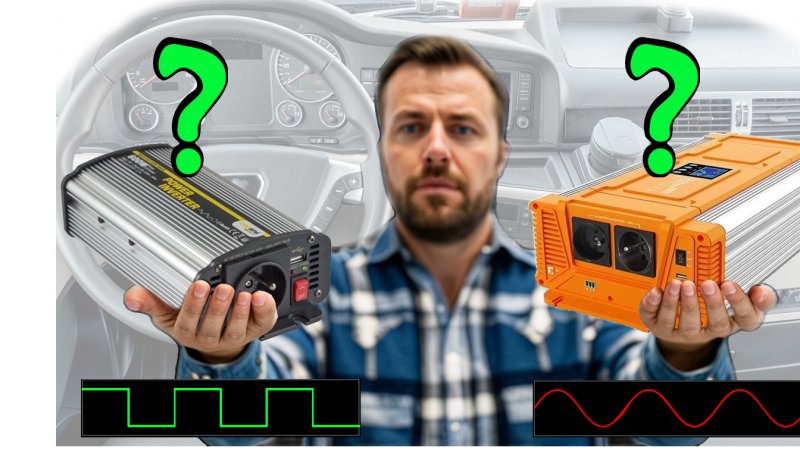
The most common inverters convert voltage from 24V to 12V or 230V, or from 12V to 230V. Most available models offer an output voltage with a modified, or trapezoidal, sine wave. This type is not suitable for sensitive appliances that require a pure sine wave—which is provided by more reliable inverters with a smooth voltage waveform, similar to what you find in standard wall outlets.
Converters with a square-wave output are the least expensive and suitable for simple appliances such as light bulbs and chargers. A modified sine wave is better for lighting, heating elements, or devices with switching power supplies, such as laptops. For complex appliances, a pure sine wave will be necessary; it can handle even induction motors and is reliable for long-term operation, albeit at a higher price.
Inverters with UPS Functionality
These inverters function as backup power sources and ensure a stable power supply during power outages. They are connected to the grid and charge the battery, drawing power from the battery in the event of an outage.
Power Rating and Inverter Selection
Choosing the right power rating is crucial. Make sure the inverter can handle all your appliances, especially the energy-intensive ones. For normal use, a load of up to 80% of the inverter’s power rating is recommended. To calculate the required power, use the formula: voltage (V) × current (A) = power consumption (W). Choose an inverter with a power rating at least 1.5–2 times higher than the power consumption of your most powerful appliance.
Input and Output Voltage
In vehicles, the typical input voltage is 12V, which the inverter converts to 230V. Trucks often have 24V. Some inverters also have USB ports for charging smaller devices.
Sine-wave inverters
Based on quality, voltage inverters can be divided into two groups according to their output sine wave. The cheaper models have a “more angular,” rectangular, or modified sine wave.
The more the output sine wave resembles a smooth sine wave, the higher the quality of the inverter. We strongly recommend the sine wave type for rotating machinery, refrigerators, measuring instruments, and certain coffee makers.
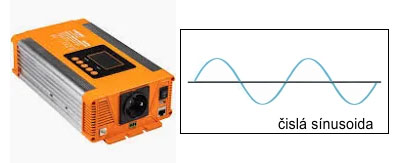
Pros—Advantages of a Pure Sine Wave Inverter
+ Can be used without issues with all electrical appliances; it produces a pure sine wave like that found in a standard 230V
household electrical system + There is no need to “oversize” the inverter’s
power rating
Cons – Disadvantages of a sine wave inverter
- Higher price
Modified sine wave inverters.
Cheaper inverters are suitable for resistive loads such as electric kettles, simple motors, chargers, incandescent bulbs, and other simple appliances.
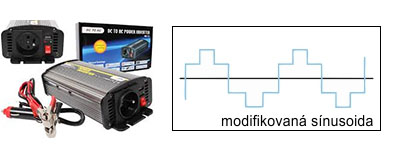
Pros – Advantages of a modified sine wave voltage converter
+ lower price
Cons – Disadvantages of modified sine wave inverters
- Cannot always be used with all electrical devices; there are sometimes issues with more complex electronics
- Power must be sufficiently oversized; for synchronous motors, up to 8 times the required power

Price and Safety
Inverter prices range from 1,000 to 10,000 CZK, depending on power output and waveform type. High-quality inverters are equipped with protection against overvoltage, overload, and other safety features. Be sure to read the manual before use to avoid the risk of injury or damage to the equipment.